Last updated June 15, 2026
Garage Door Repair Maintenance Checklist for Santa Barbara Homeowners
Here’s something most Santa Barbara homeowners don’t realize: the biggest threat to your garage door isn’t a broken spring or a failing opener — it’s salt air. The coastal climate along the South Coast accelerates corrosion on torsion springs, hinges, and tracks at a rate that’s measurably faster than inland communities just 30 miles away. We’ve replaced springs in Montecito that looked fine from the outside but had corroded through 40% of their core. A routine visual check won’t catch that. This guide gives you a complete, seasonally aware maintenance checklist built specifically for Santa Barbara conditions — not a copy-pasted template from a Phoenix garage door company.
Quick Answer
A complete garage door maintenance checklist for Santa Barbara homeowners covers monthly visual inspections, quarterly lubrication with a salt-resistant lubricant, annual spring and cable tension checks, and seasonal weatherstripping replacements — typically needed more often here than in drier inland climates. Because Santa Barbara’s coastal air accelerates metal corrosion and our marine layer keeps hardware damp overnight, most doors in this area need more frequent attention than the manufacturer’s standard maintenance schedule suggests. Run through this checklist every 90 days and you’ll catch 80% of problems before they become emergency calls.
Table of Contents
- Why Santa Barbara’s Climate Demands a Different Maintenance Approach
- Monthly Visual Inspection Checklist
- Quarterly Maintenance Steps (Lubrication & Hardware)
- Annual Deep Inspection: Springs, Cables, and Panels
- Garage Door Opener Maintenance
- Weatherstripping and Seals: Santa Barbara-Specific Guidance
- Common Mistakes to Avoid
- When to Call a Professional
- Frequently Asked Questions
- The Bottom Line
Why Santa Barbara’s Climate Demands a Different Maintenance Approach
Standard garage door maintenance guides are written for average conditions. Santa Barbara is not average. The combination of salt-laden marine air, morning marine layer humidity that settles on metal hardware, periodic Santa Ana wind events that drive dust and debris into tracks, and the occasional heavy rain after months of dry heat creates a stress cycle that most garage door components weren’t specifically engineered to handle.
In neighborhoods like the Mesa, Riviera, and the beachside streets of Carpinteria, we regularly see spring corrosion showing up 18 to 24 months earlier than it would on a comparable door in a drier inland setting. Galvanized springs fare better, but they’re not immune — a spring that looks silver and intact can have significant internal fatigue from cyclic moisture exposure.
The Santa Ana winds are a separate problem. When a dry, fast-moving Santa Ana event pushes through the passes, fine grit gets forced into every gap in your door’s track and roller system. That grit combines with whatever lubricant is already in the track and creates an abrasive paste that accelerates wear on nylon rollers and can score the inside of steel tracks. After any significant Santa Ana event, a quick track wipe-down is worth five minutes of your time.
The bottom line: if you’re using maintenance intervals you found in a door manufacturer’s PDF written for a national audience, bump everything up by about 30%. In Santa Barbara, quarterly maintenance replaces semiannual, and annual replaces biennial for most hardware checks.
Monthly Visual Inspection Checklist
A monthly inspection takes under ten minutes and catches the early warning signs that prevent larger repairs. You’re not testing mechanical systems here — you’re using your eyes and ears to notice what’s changed.
- Watch the door move through a full cycle. Open and close it completely, standing inside the garage with the lights on. Look for jerking, hesitation at any point in the travel, or one side moving faster than the other (a sign of uneven spring tension).
- Listen for new sounds. Grinding, popping, or squealing that wasn’t there last month is always significant. A new grinding sound on a Clopay or Wayne Dalton door with steel rollers often means a bearing is starting to fail.
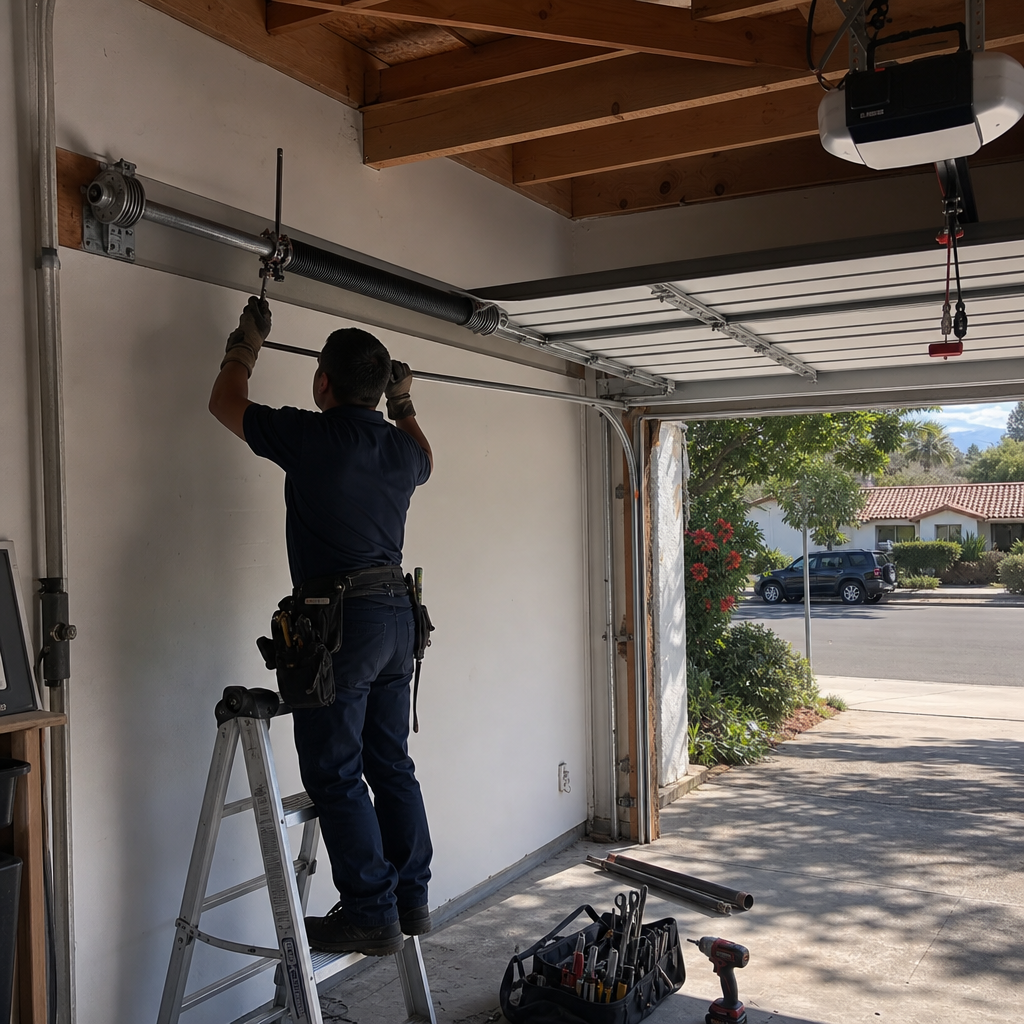
- Check the spring visually. Don’t touch it — just look. Any visible gap in the coils of a torsion spring means it has broken. Any rust streaking running lengthwise along the spring is active corrosion and should be noted for your next professional service visit.
- Inspect the cables. Look at the lift cables that run from the bottom corners of the door up to the drums. Fraying, kinking, or uneven slack on one side is a sign the cable is near failure.
- Check the weatherstripping bottom seal. Look for gaps, cracking, or sections that have pulled away from the door. A compromised bottom seal in Santa Barbara means moisture, critters, and salt air get direct access to your door’s interior hardware.
- Test the auto-reverse safety feature. Place a two-by-four flat on the ground in the door’s path and trigger a close cycle. The door should reverse immediately on contact. If it doesn’t, stop using the opener and call for service — this is a safety system, not a convenience feature.
- Check the wall button and keypad. Slow response or intermittent non-response is usually a sign that the battery in the keypad is low or that a wire connection at the wall button has worked loose — both are quick fixes if caught early.
Quarterly Maintenance Steps (Lubrication & Hardware)
Every 90 days, move beyond the visual check into hands-on maintenance. Given Santa Barbara’s coastal conditions, this interval keeps corrosion and wear from building to the point where parts need replacing rather than just maintaining.
What to Lubricate — and What Not To
Use a lithium-based or silicone-based spray lubricant. We specifically recommend against WD-40 for garage door hardware — it’s a solvent and a water displacer, not a durable lubricant, and in humid coastal air it evaporates quickly, leaving hardware drier than before. Brands like 3-IN-ONE Professional Garage Door Lubricant or the lubricant sold by LiftMaster for their hardware are both appropriate choices for Santa Barbara conditions.
- Torsion spring: Apply a light coat along the full length of the coils. This slows surface corrosion in marine air environments.
- Hinges: One or two sprays at the pivot point of each hinge. Wipe off excess — pooled lubricant attracts the fine grit that Santa Ana winds carry.
- Rollers: If your door has steel rollers with exposed bearings, apply lubricant to the bearing. Do not lubricate nylon rollers — they run dry by design.
- Tracks: Do NOT lubricate the inside of the tracks. Wipe them clean with a rag instead. Lubricant in the track creates the abrasive paste problem mentioned earlier.
- Lock and latch mechanism: A light spray keeps the lock turning freely and prevents the salt-air seizing that makes manual locks difficult to operate after a year of neglect.
Hardware Tightening
A standard residential garage door opens and closes roughly 1,500 times per year. That’s a lot of vibration on every bolt, nut, and bracket. Quarterly, run a socket wrench over the bolts connecting the track brackets to the wall and ceiling, the bolts on the door hinges, and the bolts securing the opener to the ceiling mount. Don’t overtighten — snug is the target. Stripped hardware is harder to fix than loose hardware.
Annual Deep Inspection: Springs, Cables, and Panels
Once a year, your garage door deserves a thorough assessment of every load-bearing component. In Santa Barbara, we recommend scheduling this in late fall — after the dry summer season has done its work on rubber seals and before winter rains arrive. This is also a good time to assess whether your door’s appearance has weathered past the point where a fresh coat of paint or a panel replacement makes sense, particularly if you’re in a neighborhood like Montecito or Hope Ranch where curb appeal has real property value implications.
Spring Tension Test
Disconnect the opener (pull the red emergency release cord) and manually lift the door to waist height. Release it. A properly balanced door will stay in place, moving neither up nor down. If it drops, the springs are under-tensioned and the opener is compensating — which accelerates opener motor wear. If it rises, the springs are over-tensioned. Either condition shortens the life of your opener and increases the load on every other component in the system. Spring adjustment is a professional task — the stored energy in a torsion spring can cause serious injury if released improperly.
Cable and Drum Inspection
Look closely at the lift cables where they wrap around the drums at the top of the door. This is where cables fray first — the repeated bending around the drum fatigues the wire strands. Any visible fraying means the cable should be replaced before it snaps. A snapped cable typically drops one side of the door suddenly, which can damage panels, the opener carriage, and anything in the door’s path.
Panel Condition Check
Inspect each panel section for dents, cracks, or water infiltration along the bottom sections. In Santa Barbara, wood doors on older craftsman-style homes in the Upper East and downtown historic district often show water damage along panel edges after wet winters. This isn’t just cosmetic — swollen panels bind in their tracks and put abnormal stress on the opener. If you’re considering panel replacement or a full new door, Garage Door Installation in Santa Barbara covers what to expect from that process.
Garage Door Opener Maintenance
Your opener is the most electronically complex component in the system, and it’s also the one most homeowners treat as a set-it-and-forget-it device until it stops working. A few simple steps once a year extend the life of units from LiftMaster, Chamberlain, Genie, Craftsman, and every other major brand significantly.
- Clean the photo-eye sensors. The two small sensors near the floor on either side of the door get dusty, and in Santa Barbara’s coastal environment, they can develop a film of salt residue that interferes with the safety beam. Wipe both lenses with a soft cloth monthly. Misaligned or dirty photo eyes are the most common reason a door won’t close.
- Check the drive system. Chain-drive openers need their chain checked for sag — too much slack causes the chain to slap the rail and accelerates sprocket wear. Belt-drive openers should be inspected for cracking. Screw-drive openers benefit from lubricant applied to the screw rod once a year.
- Test battery backup. Many newer LiftMaster and Chamberlain units have battery backup systems. Test them annually by unplugging the opener from the outlet and running through a full open-close cycle on battery power alone. Replace backup batteries every two to three years regardless of whether the unit seems fine.
- Update remote batteries. A remote that’s getting slow to respond or requires multiple button presses is running on a dying battery. Replace it — continuing to use it causes the opener to strain to receive the signal, and repeated failed-transmission attempts are logged internally on many smart openers.
If your opener is more than 12 to 15 years old and showing signs of strain, the question shifts from maintenance to replacement. Garage Door Opener in Santa Barbara covers current models, what to expect on cost, and what the installation process involves.
Weatherstripping and Seals: Santa Barbara-Specific Guidance
Weatherstripping on a Santa Barbara garage door works harder than most homeowners appreciate. It’s not just keeping rain out — it’s preventing the slow infiltration of salt-laden air that accelerates the corrosion of everything inside your garage, including your car’s undercarriage if you park indoors.
Bottom Seal (Door Sweep)
The bottom seal sits between the door’s lowest panel and the concrete floor. In Santa Barbara, UV exposure from the strong Southern California sun degrades rubber seals faster than in northern California markets. Check the bottom seal twice a year — spring and fall — and plan to replace it every two to three years rather than the four-to-five-year interval that’s often cited in national maintenance guides. Vinyl T-slot bottom seals last longer than standard rubber in high-UV applications.
Vertical and Top Weatherstripping
The seals along the sides and top of the door frame are often overlooked until light is visible around the closed door. Gaps here allow wind-driven moisture and — during strong Santa Anas — fine particulate matter to enter. These seals are inexpensive and take under an hour to replace with basic tools.
Between-Panel Seals
Sectional doors have seals between each panel section. These are frequently forgotten because they’re not visible at eye level. After several years of UV exposure, they become brittle and crack, which allows water to penetrate between sections during heavy rain events. In Santa Barbara’s wet winters, damaged between-panel seals on a wood door can accelerate panel swelling significantly.
Common Mistakes to Avoid
- Using WD-40 as a lubricant. It’s a common mistake we see constantly. WD-40 is a water displacer and solvent — it actually strips the lubricant that was already on your springs and hinges. Use a proper lithium or silicone garage door lubricant instead.
- Ignoring a door that’s “just a little slow.” A door that’s slower than it used to be is telling you something — usually a spring that’s losing tension or a roller that’s starting to bind. In Santa Barbara, slow-developing spring fatigue from coastal corrosion often presents as gradual slowness before a sudden failure.
- Lubricating the tracks. The inside running surface of the track should stay clean and dry, not lubricated. Lubricant in the track mixes with grit and creates drag, not reduction of it. This is one of the most frequently repeated bad-advice items we see online.
- Adjusting spring tension yourself. Torsion springs store enough energy to cause serious injury. This is the one maintenance task on this list that should never be DIY’d. We’ve seen emergency calls in Santa Barbara from homeowners who attempted spring adjustment with a winding bar and lost control of the process.
- Skipping maintenance after a Santa Ana wind event. After a significant Santa Ana blows through, track contamination and increased hardware wear are near-certainties. A quick wipe-down and inspection takes ten minutes and prevents accelerated wear from the grit left behind.
- Assuming a new door doesn’t need maintenance. A newly installed Clopay, Amarr, or Raynor door still needs lubrication, hardware checks, and balance tests from day one. Factory lubrication on springs isn’t designed to last more than a few months in coastal conditions.
- Waiting until the door fails completely to call for service. In Santa Barbara’s real estate market, a non-functioning garage door affects home access, security, and property value. Most failures we respond to as emergency calls showed warning signs — sounds, slowness, visible rust — weeks or months earlier.
When to Call a Professional
Some maintenance tasks are genuinely appropriate for a capable homeowner with basic tools. Others are not — and the line matters more with garage doors than with most home systems because of the forces involved.
Call a professional when you see a gap in your torsion spring (it’s broken), when your cables are fraying or one side of the door hangs lower than the other, when the door fails the balance test and won’t hold at waist height, when the auto-reverse safety feature doesn’t trigger on contact, or when you hear a sudden loud bang from the garage — that’s typically a spring snapping under tension.
Also call when the door’s symptoms don’t match anything obvious. In 18 years of working on garage doors across Santa Barbara, Mark Thomas has seen problems that looked like spring issues but were actually failing roller bearings, and opener problems that were actually broken cable drums. Correct diagnosis matters — the wrong repair wastes money and leaves the real problem in place.
Garage Door Repair in Santa Barbara covers repair services in detail. For a free estimate or same-day emergency service, call (877) 793-3714. Fast Track Garage Door Repair Santa Barbara offers free estimates — no charge to have Mark come out and tell you exactly what’s going on.
Frequently Asked Questions
How often should I lubricate my garage door in Santa Barbara?
Every 90 days is the right interval for Santa Barbara’s coastal climate — more often than the semiannual schedule most national manufacturers recommend. Salt air and marine layer humidity accelerate the drying of lubricant on springs, hinges, and rollers. A lithium-based or silicone-based garage door lubricant works best; apply it to springs, hinges, and roller bearings (not the tracks) each quarter. If your garage faces the ocean or you’re in the Mesa or Riviera neighborhoods, lean toward the shorter end of that interval. Call (877) 793-3714 if you’d like Mark to do a lubrication and inspection service — estimates are free.
What are the signs that my garage door spring needs replacement in Santa Barbara?
A visible gap in the torsion spring coil means it’s already broken — that’s the obvious sign. Earlier warning signs include the door rising unevenly (one side higher than the other), the door feeling unusually heavy when you lift it manually, the opener straining audibly through the cycle, or visible rust streaking running along the spring’s length. In Santa Barbara, corrosion-related spring fatigue is more common than mechanical fatigue from cycle count alone, particularly in homes within a mile of the ocean. Don’t attempt to diagnose or adjust springs yourself — call (877) 793-3714 for a free assessment.
Can I do garage door maintenance myself, or do I need a professional?
Most of the monthly and quarterly checklist items in this guide — visual inspection, lubrication, hardware tightening, sensor cleaning — are appropriate DIY tasks for a homeowner comfortable with basic tools. The tasks that should always go to a professional are spring tension adjustment, cable replacement, and any repair involving the high-tension hardware at the top of the door. The risk isn’t theoretical: torsion springs store significant mechanical energy and can cause serious injury if handled incorrectly. When in doubt, a free estimate from a qualified technician costs nothing and gives you a clear picture of what actually needs doing.
How long do garage door springs typically last in Santa Barbara?
Standard torsion springs are rated for roughly 10,000 cycles, which translates to about seven to nine years for an average household. In Santa Barbara’s coastal microclimate, that effective lifespan shortens to five to seven years for homes close to the water, because corrosion degrades the spring’s cross-section independently of cycle fatigue. Galvanized springs last longer in coastal conditions and are worth requesting when springs are replaced. If your home is in Carpinteria, the Mesa, or anywhere with regular marine layer exposure, budget for spring replacement every five to six years rather than the standard seven to nine.
Why does my garage door open but not close — or close but not open?
A door that won’t close is most commonly a photo-eye issue: the two sensors near the floor are either misaligned or have a film of dust or salt residue blocking the safety beam. Check that both sensor lights are solid (not blinking) and wipe the lenses clean. A door that won’t open but the opener is running usually points to a broken spring — the opener can’t overcome the full weight of the door without spring assistance. Both scenarios are diagnosable in under ten minutes by a technician. Call (877) 793-3714 for same-day service if the door is stuck in a position that affects security.
What’s the best garage door material for Santa Barbara’s coastal climate?
Steel doors with a factory-applied primer and paint system hold up better than raw steel or unfinished wood in Santa Barbara’s salt-air environment, particularly in neighborhoods like the Mesa or beachside Montecito. Fiberglass and composite doors are the strongest performers against moisture and salt corrosion, though they carry a higher upfront cost. Wood doors require more maintenance — annual sealing or painting — and show the effects of wet winters along panel edges faster than any other material. If you’re replacing a door, brands like Clopay and Amarr offer steel construction with strong factory finishes specifically tested for coastal conditions. For a full look at options, visit Fast Track Garage Door Repair Santa Barbara, home or call (877) 793-3714 to talk through what fits your home and budget.
The Bottom Line
A garage door is one of the most mechanically active systems in your home — the average Santa Barbara household puts roughly 1,500 cycles on it every year. The checklist in this guide isn’t busywork. Monthly visual checks catch failures before they become emergencies. Quarterly lubrication with the right product keeps coastal corrosion from shortening component life. Annual spring and cable assessments catch the structural issues that cause sudden failures. And knowing where the DIY line is — and where to stop and call a professional — keeps you safe and keeps your repair costs predictable. A well-maintained door lasts significantly longer, operates more reliably, and costs far less over its lifetime than a neglected one.
If anything on this checklist surfaces a problem you’re not sure how to address, Mark Thomas and the team at Fast Track Garage Door Repair Santa Barbara are straightforward to reach. Eighteen years of working on garage doors across Santa Barbara means the diagnosis is fast and the fix is the right one the first time — backed by 1,826 five-star reviews from homeowners who’ve been through exactly what you’re dealing with. Call (877) 793-3714 for a free estimate. No runaround, no upsell — just a clear answer and a lasting fix.
Written by Mark Thomas, Owner & Lead Technician at Fast Track Garage Door Repair Santa Barbara, serving Santa Barbara since 2008.