Last updated June 15, 2026
The Complete Guide to Garage Door in Santa Barbara
Here’s something most Santa Barbara homeowners don’t realize until it’s too late: the marine layer that rolls in off the Pacific nearly every morning isn’t just hard on paint and wood trim — it’s quietly destroying your garage door hardware. Salt air accelerates metal fatigue on springs, cables, and hinges at a rate roughly two to three times faster than inland California climates. That means a torsion spring that might last 10,000 cycles in Phoenix or Fresno can start showing stress fractures in Santa Barbara in half that time. In this guide, we’ll walk you through everything you need to know about garage doors in Santa Barbara — from choosing the right materials for our coastal environment to understanding repair costs, installation options, opener technology, and when to call in a specialist before a small problem becomes an expensive one.
Quick Answer
A complete garage door guide for Santa Barbara covers five core areas: choosing the right door material for our coastal climate, understanding repair vs. replacement costs, selecting the right opener, knowing which brands perform best locally, and recognizing the warning signs that require a professional. Santa Barbara’s salt air, fog, and mild-but-variable temperatures create specific maintenance demands that generic national guides overlook — the advice here is built around what we actually see on jobs in this market every day.
Table of Contents
- How Santa Barbara’s Climate Affects Your Garage Door
- Choosing the Right Garage Door Material
- Garage Door Repair vs. Replacement: What Makes Sense in Santa Barbara
- How Much Does Garage Door Service Cost in Santa Barbara?
- Choosing a Garage Door Opener in Santa Barbara
- Best Garage Door Brands for Santa Barbara Homes
- A Step-by-Step Garage Door Maintenance Routine
- Common Mistakes to Avoid
- When to Call a Professional
- Frequently Asked Questions
- The Bottom Line
How Santa Barbara’s Climate Affects Your Garage Door
Santa Barbara sits in a narrow coastal corridor where morning marine layer, afternoon sun, and salt-laden air create a uniquely demanding environment for any exterior hardware. Most homeowners think of their garage door as a static structure — it just sits there. In reality, it’s a mechanical system with 100+ moving parts that cycles open and closed thousands of times a year while being exposed to conditions that actively corrode metal, warp wood, and degrade rubber seals.
The neighborhoods closest to the water — Carpinteria-adjacent stretches, the lower East Side, Westside properties near the harbor, and homes in the Mesa area — see the most aggressive salt air exposure. We’ve pulled springs off doors in those ZIP codes that looked like they had a decade of rust in just three or four years. Even further inland, in areas like San Roque, Hope Ranch, or the lower Riviera, the fog that funnels up through the canyons carries enough moisture to accelerate corrosion on bare steel components.
What this means practically:
- Galvanized or stainless-coated springs are worth the price premium in Santa Barbara — standard carbon steel springs corrode faster here than the industry averages suggest.
- Wood doors require more frequent sealing and repainting than manufacturers rate them for inland climates.
- Bottom seals and weatherstripping degrade faster due to UV exposure from our strong afternoon sun combined with the moisture cycle — plan to replace them every two to three years rather than the five manufacturers often advertise.
- Opener circuit boards in garages without climate control can experience condensation cycling that shortens their lifespan — proper ventilation matters here.
Building your maintenance schedule and your product choices around Santa Barbara’s actual conditions — not national averages — is the single highest-leverage thing you can do to extend the life of your garage door system.
Choosing the Right Garage Door Material
Material selection is probably the most consequential decision you’ll make about your garage door, and in Santa Barbara, it deserves more thought than “what looks good on the house.” Every material has a real-world performance profile in coastal conditions.
Steel
Steel is the most popular choice, and for good reason — it’s durable, relatively low-maintenance, and available in a wide range of styles from brands like Clopay, Amarr, and Wayne Dalton. For Santa Barbara specifically, look for doors with a baked-on polyester finish rather than painted steel, and consider upgrading to a 25-gauge or heavier panel. Thicker steel resists denting and holds its finish longer against the marine layer. A steel door with a polyurethane foam core also gives you better insulation, which matters if your garage is attached and you’re trying to keep interior temperatures stable.
Aluminum
Aluminum doesn’t rust, which makes it genuinely attractive for Santa Barbara’s coastal neighborhoods. It’s lighter than steel, which reduces wear on springs and opener motors over time. The trade-off is that aluminum dents more easily and, in thinner gauges, offers less insulation. Contemporary aluminum-framed glass panel doors are a popular architectural choice in the Mesa, Westside, and Riviera areas — they look great on modern or mid-century homes but require regular cleaning to prevent salt film buildup on the glass.
Wood
Wood garage doors are beautiful and common in Santa Barbara’s older Spanish Colonial, Craftsman, and ranch-style homes. But they’re the highest-maintenance option in this climate. Expect to repaint or reseal every two to three years, and inspect regularly for moisture intrusion at the bottom panel — that’s where rot typically starts. If you love the look but not the upkeep, wood composite or faux-wood steel doors from Clopay or Raynor give you the aesthetic with significantly less maintenance burden.
Fiberglass and Vinyl
These materials won’t rust or rot, and they’re increasingly available in realistic wood-grain finishes. Fiberglass can crack under impact and becomes brittle with age in high-UV environments — Santa Barbara’s sun exposure is a real factor here. Vinyl is more forgiving but limited in design options. Both are viable low-maintenance choices for the right situation.
Garage Door Repair vs. Replacement: What Makes Sense in Santa Barbara
This is the question we get asked most often, and the honest answer isn’t “always repair” or “always replace” — it’s situational. Here’s how to think through it.
Repair makes sense when:
- The door itself is structurally sound and less than 15 years old.
- The problem is isolated — a broken spring, failed cable, worn roller, or malfunctioning opener.
- The door’s style and insulation rating still suit your needs.
- Total repair cost is less than 40–50% of a new door’s installed price.
Replacement makes sense when:
- The door has multiple panel cracks or significant structural damage.
- You’re seeing repeated repairs within a short window — that’s the door telling you something.
- The door is an older, uninsulated single-layer panel and you want better energy performance.
- You’re renovating or selling and want to maximize curb appeal — in Santa Barbara’s real estate market, a new door has a strong return on investment.
In our experience working across Santa Barbara neighborhoods, homeowners tend to under-invest in doors on homes they’ve owned 10+ years, letting repairs stack up past the point where replacement is clearly the smarter financial decision. If a door is giving you problems every 12 to 18 months, the math usually tips toward replacement. For a detailed look at the repair side, Garage Door Repair in Santa Barbara covers specific repair scenarios and what to expect from each.
How Much Does Garage Door Service Cost in Santa Barbara?
Pricing in the Santa Barbara market runs somewhat higher than the national average, reflecting both the coastal cost of living and the additional material and labor considerations that come with working in a salt-air environment. Here are realistic ranges for the most common services based on what this market actually looks like:
| Service | Typical Santa Barbara Range |
|---|---|
| Torsion spring replacement (single) | $180 – $280 |
| Torsion spring replacement (double) | $250 – $380 |
| Cable replacement (per side) | $95 – $160 |
| Roller replacement (full set) | $120 – $200 |
| Opener installation (belt or chain drive) | $280 – $450 installed |
| New door installation (single, standard) | $900 – $1,800 installed |
| New door installation (double, insulated) | $1,400 – $3,200 installed |
| Emergency same-day service | $150 – $250 service call premium |
These ranges reflect parts and labor together. Any quote you receive that is significantly below these numbers deserves scrutiny — in our experience, extremely low bids in this market typically involve inferior-grade springs (lighter-duty than spec), non-OEM parts, or technicians who are cutting corners on the install. Call (877) 793-3714 for a free, upfront estimate with no surprise fees.
Choosing a Garage Door Opener in Santa Barbara
The opener is the component most homeowners interact with dozens of times a week and think about least until it fails. In Santa Barbara, there are a few selection factors that go beyond the standard drive-type comparison.
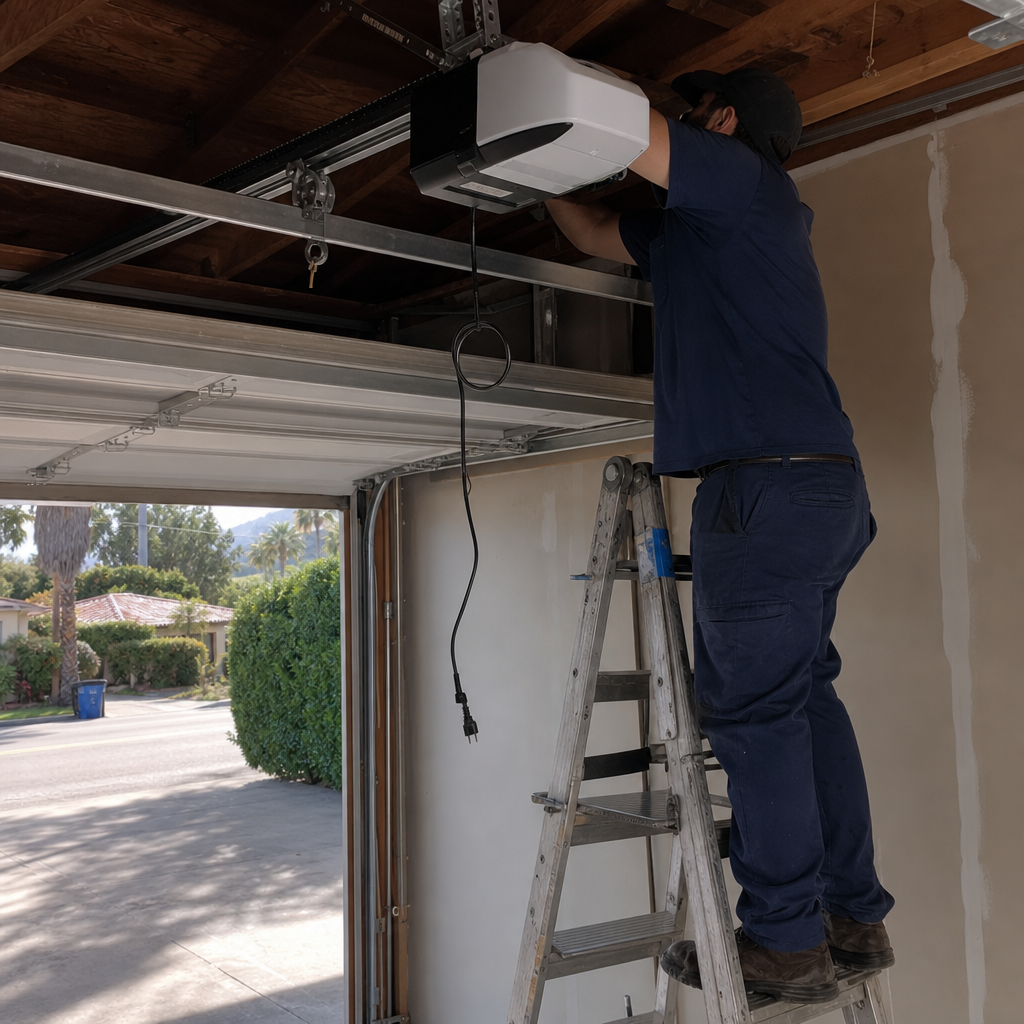
For a full breakdown of installation options and smart features, see our Garage Door Opener in Santa Barbara page. Here are the key decision points:
Drive Type
- Belt drive: Quietest option — ideal for attached garages directly below living spaces, which is common in Santa Barbara’s dense residential neighborhoods. Brands like LiftMaster and Chamberlain make excellent belt-drive units that hold up well in coastal humidity.
- Chain drive: More affordable, mechanically simple, louder. Better suited to detached garages where noise isn’t a factor.
- Direct drive / screw drive: Fewer moving parts means less to maintain. Good option for homeowners who prefer low-maintenance hardware.
Smart Features
Wi-Fi enabled openers from LiftMaster and Chamberlain allow you to monitor and control your garage remotely — a practical feature for Santa Barbara homeowners who travel or have vacation properties. The myQ platform in particular integrates with Amazon Key and other smart home systems and has proven reliable in our local installs.
Battery Backup
Santa Barbara experiences power outages, particularly during wind events in fall and winter. An opener with battery backup — available on many LiftMaster and Genie units — means your door still works when the power goes out. This isn’t optional if accessibility is a priority or if your garage is your primary entry point.
Motor Size
Heavier doors — particularly insulated double doors or solid wood doors common on Santa Barbara’s older properties — need at least a 3/4 HP motor. Undersizing the motor is a common mistake that leads to premature wear on both the opener and the door’s spring system.
Best Garage Door Brands for Santa Barbara Homes
We work on every major brand regularly across Santa Barbara, and while all of the following are quality products, each has a particular strength worth knowing about when you’re making a purchase decision.
- Clopay: The broadest range of residential styles, from traditional raised-panel to contemporary glass. Their Gallery and Coachman lines are especially popular in Santa Barbara’s Spanish Colonial and traditional home stock. Good corrosion resistance on their higher-tier coatings.
- Amarr: Solid mid-range value with consistent panel quality. Their Heritage and Classica lines work well on craftsman and ranch-style homes. Widely available parts, which matters for long-term serviceability.
- Wayne Dalton: Known for their innovative TorqueMaster spring system (enclosed, reducing exposure to salt air — a real advantage here). Good architectural fit for contemporary and custom homes.
- Raynor: A commercial-grade option that holds up well in high-use residential applications. Good choice if your garage sees heavy daily traffic.
- LiftMaster / Chamberlain: The gold standard in opener technology. We install and service these more than any other brand in Santa Barbara — parts availability, support infrastructure, and smart home integration are all best-in-class.
- Genie: Competitive opener alternative to LiftMaster with solid reliability. Their Excelerator and SilentMax lines are well-regarded.
- Craftsman: A familiar name with decent entry-level openers — parts are widely available, which helps for older units still in service across Santa Barbara’s housing stock.
If you’re ready to explore a new door, Garage Door Installation in Santa Barbara walks through the full installation process and what to expect on the day of your install.
A Step-by-Step Garage Door Maintenance Routine
A consistent maintenance routine is the single best investment you can make in your garage door’s lifespan — especially in Santa Barbara’s coastal environment. This takes about 30 minutes twice a year. Do it in spring (after the rainy season) and fall (before winter storms).
- Visual inspection: Stand inside your garage with the door closed and look at every panel, hinge, roller, cable, and spring. Look for rust, cracks, frayed cables, or loose hardware. In Santa Barbara, pay close attention to any bare metal — surface rust here moves fast.
- Test the balance: Disconnect the opener by pulling the red emergency release cord. Manually lift the door to waist height and let go. A properly balanced door stays put. If it drifts up or down, the spring tension is off and needs professional adjustment — don’t try to adjust torsion springs yourself.
- Lubricate moving parts: Apply a silicone-based or lithium-grease spray to hinges, rollers, and the torsion spring. Do not use WD-40 — it’s a solvent, not a lubricant, and it removes the protective oil film. In Santa Barbara, lubricate every six months rather than the once-a-year interval you’ll see in generic guides.
- Inspect and clean the tracks: Wipe the tracks clean with a damp cloth. Look for dents or misalignment. Don’t lubricate the tracks — debris sticks to lubricated tracks and accelerates wear on rollers.
- Check the weatherstripping and bottom seal: These degrade faster in Santa Barbara’s UV-heavy afternoon sun. Replace the bottom seal if it’s cracked, stiff, or no longer making full contact with the ground. This is also your first line of defense against moisture intrusion during our winter storms.
- Test the auto-reverse safety feature: Place a 2×4 flat on the ground in the door’s path and close it. The door should reverse immediately upon contact. If it doesn’t, the force settings need adjustment — this is a safety-critical check.
- Rinse hardware in coastal zones: If your home is within a half-mile of the ocean — think the Mesa, lower Westside, Carpinteria-adjacent properties — rinse exposed hardware with fresh water after periods of heavy onshore wind. It takes five minutes and meaningfully slows salt corrosion.
Common Mistakes to Avoid
- Attempting to adjust or replace torsion springs yourself. Torsion springs are under extreme tension — a spring failure during DIY adjustment can cause serious injury. This is one of the most common ER-visit causes in home repair, and it’s entirely avoidable. Let a professional handle it.
- Choosing a door material based on national reviews rather than local climate performance. A wood door that gets glowing reviews in dry Arizona climates may need constant attention in Santa Barbara’s marine layer environment. Always factor in how a material performs in coastal conditions specifically.
- Ignoring a slow or laboring door. A door that’s slower than usual or sounds different is telling you something — usually a spring losing tension or a roller wearing out. Ignoring it means the opener motor compensates with extra strain, shortening its life. What’s a $120 roller fix today becomes a $350 opener replacement next year.
- Undersizing the opener motor for the door weight. This is especially common with insulated double doors, which are heavier than they look. A 1/2 HP motor on a heavy door runs hot, cycles more slowly, and burns out faster. Match the motor rating to the door weight, not just the door width.
- Skipping the salt-air rinse routine in oceanfront neighborhoods. Homeowners in the Mesa, lower Eastside, and harbor-adjacent areas often don’t realize how quickly bare steel hardware oxidizes with regular salt exposure. A fresh-water rinse of exposed springs, hinges, and tracks every few weeks during heavy marine layer season adds years to hardware life.
- Hiring a general handyman for spring or cable work. Springs and cables are under significant mechanical load. The consequences of a misdiagnosed spring type, wrong wire diameter, or improperly wound installation aren’t just inconvenient — they’re dangerous. This work requires specific knowledge of door weights, cycle ratings, and winding techniques that general contractors typically don’t have.
- Delaying emergency repairs. A garage door that won’t fully close is a security vulnerability, not just an inconvenience. In a neighborhood like Santa Barbara — where attached garages often provide direct interior home access — an unsecured door is a real risk. Same-day emergency repair exists for exactly this reason.
When to Call a Professional
Some garage door tasks are genuinely DIY-friendly: lubricating hinges, replacing a worn bottom seal, cleaning tracks, or reprogramming a remote. Everything else on this list warrants a call to someone who does this work every day.
Call a professional when:
- A torsion or extension spring has broken — these are dangerous to handle without proper tools and training.
- A cable has snapped or jumped off the drum — the door is effectively non-functional and under uneven tension.
- The door comes off its tracks — forcing it back without addressing the underlying cause usually makes things worse.
- The opener runs but the door doesn’t move — this signals a stripped drive gear, broken trolley, or disconnected carriage.
- The door is making grinding, scraping, or banging noises it wasn’t making before — that’s a component failure in progress.
- The door won’t fully close or open — a security and safety issue that should be treated as urgent.
Fast Track Garage Door Repair Santa Barbara offers free estimates in Santa Barbara with no obligation — Mark Thomas comes out, diagnoses the problem accurately, and gives you a straight answer on what it’ll take to fix it. Call (877) 793-3714 and we’ll have someone to you fast.
Frequently Asked Questions
How long do garage door springs last in Santa Barbara?
In Santa Barbara’s coastal environment, standard torsion springs rated for 10,000 cycles typically last 7 to 10 years with regular use, compared to the 10–14 year range you’ll see in inland California climates. Salt air accelerates metal fatigue, so if your springs are past the seven-year mark and showing surface rust, proactive replacement before a break is almost always cheaper than an emergency call after one. Call (877) 793-3714 and we can assess where your springs are in their lifespan — estimates are free.
Is it cheaper to repair or replace a garage door in Santa Barbara?
Repair is almost always cheaper in the short term, but replacement becomes the smarter financial decision when repair costs exceed 40–50% of a new door’s installed price, when the door is structurally compromised across multiple panels, or when you’re stacking repairs year over year. In Santa Barbara’s real estate market, a new door also has strong curb appeal value — which matters if you’re planning to sell. We’ll give you an honest read on which direction makes more sense after seeing the door in person.
What garage door opener is best for Santa Barbara homes?
For most Santa Barbara homes with attached garages, a belt-drive opener from LiftMaster or Chamberlain is the top choice — quieter operation and strong smart-home integration through the myQ platform. Add battery backup if your garage is your primary entry point or if power outages during wind events are a concern for your area. For detached garages or high-use situations, a chain-drive unit is more cost-effective. Call (877) 793-3714 for a recommendation matched to your specific door weight and setup.
Do I need a permit for a new garage door installation in Santa Barbara?
A standard like-for-like door replacement (same size, same opening) typically does not require a building permit in Santa Barbara. However, if you’re widening an opening, adding a new opening, or making structural changes to the garage framing, a permit through the City of Santa Barbara Building & Safety Division is required. When in doubt, we can help you confirm what applies to your specific project before work begins.
How do I know if my garage door is properly balanced?
Disconnect your opener by pulling the red emergency release cord, then manually lift the door to about waist height and let go. A properly balanced door stays in place — or moves very slightly. If it falls quickly toward the floor, the springs are under-tensioned. If it rises on its own, they’re over-tensioned. Either condition puts extra strain on your opener and accelerates wear on every component in the system. Spring tension adjustment is a job for a professional — call (877) 793-3714 and we’ll get it dialed in correctly.
Can a garage door be repaired the same day in Santa Barbara?
Yes — same-day service is available for most common repairs including broken springs, snapped cables, off-track doors, and opener failures. Emergency service is a core part of what we do at Fast Track, specifically because a broken door is rarely convenient and often a security issue. Call (877) 793-3714 early in the day for the best same-day availability, though we do our best to respond quickly whenever you call.
The Bottom Line
Your garage door is a complex mechanical system operating in one of California’s most demanding coastal climates. The decisions you make about materials, maintenance, and who you call when something breaks have a direct impact on how long it lasts and what it costs you over time. Choose materials rated for coastal conditions. Build a twice-yearly maintenance routine around Santa Barbara’s specific environment — not generic national guidelines. Know the difference between the tasks you can handle yourself and the ones that require trained hands. And when springs break, cables snap, or a door won’t move, don’t wait — those situations don’t improve on their own.
With 18 years of focused garage door work and 1,826 five-star reviews across thousands of completed jobs in Santa Barbara, Mark Thomas and the Fast Track team have seen every scenario this climate produces. We’re not a general home services company that handles doors on the side — this is all we do, and we do it right. Call (877) 793-3714 for a free estimate. Mark shows up himself, diagnoses it straight, and fixes it to last.
Written by Mark Thomas, Owner & Lead Technician at Fast Track Garage Door Repair Santa Barbara, serving Santa Barbara since 2008.